 VitaroUNO INDUSTRIAL
Technical buyer's guide
What Load Test Should I Ask for When Buying Adjustable Pedestals?
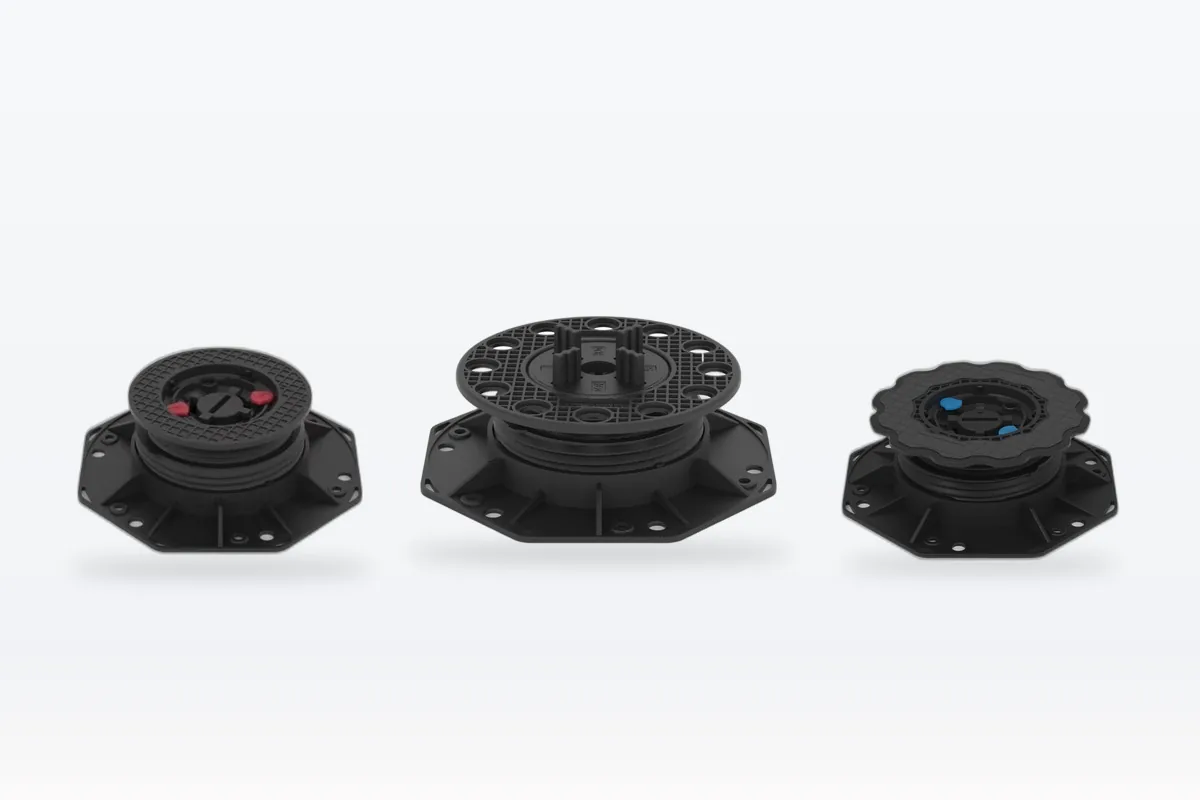
When you buy adjustable pedestals, the headline "load capacity" number is only useful if you know how it was tested. A good pedestal load test report answers four questions: how much can one pedestal carry, where the load is applied, for how long, and at what height. This guide gives you the checklist to ask suppliers — and shows how Vitaro's own SGS-tested figures (B 3,500 kg, F 2,200 kg, HE 2,000 kg) should be read with their test conditions and installation density in mind, not as a blank cheque.
1. The load test report you should ask for
Ask the supplier for a third-party load test report (Vitaro uses SGS) that states at minimum:
- Test method — what standard or in-house procedure was used (compression/static axial load).
- Per-pedestal load at minimum height — the certified working load, not a peak or burst figure.
- Finished height the rating applies to — capacity drops as the pedestal is extended.
- Temperature / ambient conditions — polypropylene behaves differently across its operating range.
- Point-load (axial) result — load applied at the centre of the head.
- Long-term / sustained result — if available, a creep test over time.
A number with no method, no height and no lab is a marketing claim, not a specification.
2. Point load vs concentrated vs distributed
These terms decide whether your terrace is safe:
| Term | What it means for a pedestal | Why it matters |
|---|---|---|
| Point load | Weight on a single spot — e.g. a heavy planter on one pedestal head | The worst case; one pedestal takes it all |
| Concentrated load | Load focused through a small area (often used interchangeably with point load in pedestal specs) | Drives the per-pedestal rating |
| Distributed load | Weight spread across many pedestals via pavers/joists | What a finished terrace actually carries |
Pedestals are certified for the per-pedestal load. A point load in one corner is the worst case, so design with a safety margin and a tight enough grid that no single pedestal is overloaded. That is why the load capacity guide sizes to about half the rated figure.
3. Long-term compression (creep)
Long-term compression testing applies a sustained load to the pedestal over time to confirm it does not permanently settle or deform under continuous weight. This matters for permanently loaded podiums and terraces. When you review a report, ask:
- Does it include a sustained/creep result, or only a short-duration peak?
- Over what duration and at what percentage of the working load?
- Was settlement (permanent deformation) measured and reported?
A pedestal that passes a one-minute peak test but creeps under a year of load is a different product. Treat the absence of a creep result as a question to raise with the supplier.
4. How to read Vitaro's ratings
Vitaro's published figures are SGS-tested working loads at minimum height:
| Series | Height range | Max load / pedestal (min height) | Best for |
|---|---|---|---|
| B Series | 20–260 mm | 3,500 kg | Standard decks & tiled terraces (highest load) |
| F Series | 20–185 mm | 2,200 kg | Low balconies & fine paving |
| HE Series | 25–392 mm | 2,000 kg | Tall rooftops & podiums (tallest build) |
These are certified working loads quoted at the shortest height. The rating falls as the pedestal is extended, so always read the figure for your finished height — the same point-load principle as above. They are not a guarantee for every project; the real limit depends on height, spacing and live load.
5. Installation density: turning rating into count
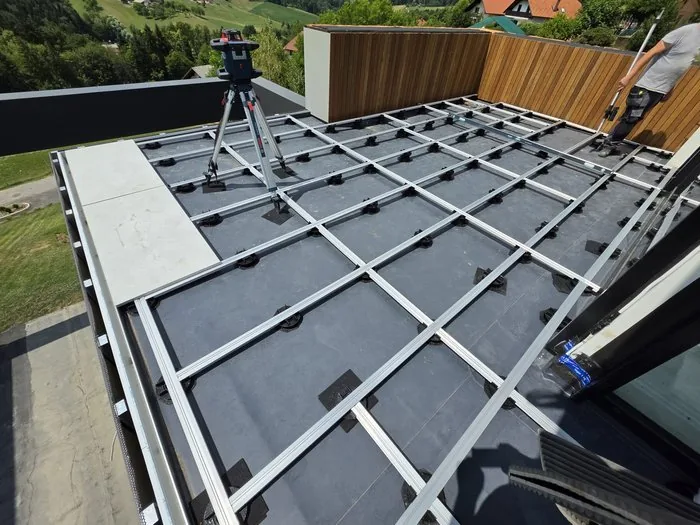
Installation density is how many pedestals you place per m² — typically 3–4 for a terrace on a 500–600 mm grid. More pedestals share the load, so each carries less and the floor stays stiff. A taller build or a heavier covering (2 cm+ porcelain) needs a tighter grid. Practical method:
- Total load = dead load (pavers/joists + pedestals) + live load (people, furniture, planters).
- Per-pedestal budget = rated load at your height ÷ 2 (safety margin). E.g. B Series at low height: 3,500 ÷ 2 ≈ 1,750 kg to design to.
- Grid: decking joists ~500 mm centres; pavers one pedestal under each 600×600 mm tile corner (4 per tile).
- Count: a 500–600 mm grid is roughly 3–4 pedestals per m².
For an exact count and spacing at your height and covering, use the Vitaro calculators or send us the dimensions.
6. Reading a report safely
- Match conditions to your job: same finished height, same material, same temperature range.
- Treat the number as a working load and size to about half of it per pedestal.
- Confirm independence: the report should come from an independent lab and cover the exact series you are buying, stating the test method.
Related guides
Load maths: Load capacity · Choose: How to choose the right pedestal · Install: Installation guide · Vs fixed: Adjustable vs fixed support.
Product specs: Deck pedestals · Paver pedestals · Roof pedestals · Heavy-duty pedestals.
Frequently asked questions
What load test report should I ask a pedestal supplier for?
Ask for a third-party load test report (Vitaro uses SGS) stating the test method, the per-pedestal load at minimum height, the finished height the rating applies to, and the ambient/temperature conditions. Check it covers static/compression load, a point-load (axial) figure, and ideally a long-term compression result. Confirm the rating is a working load, not a peak or burst load.
What is the difference between point load and distributed load for a pedestal?
A point load (or concentrated load) is weight at a single spot — e.g. a heavy planter on one pedestal head. A distributed load is spread across many pedestals via pavers or joists. Pedestals are certified for the per-pedestal load; a point load in one corner is the worst case, so design with a safety margin and a tight enough grid.
What is a long-term compression test?
Long-term compression (creep) testing applies a sustained load over time to confirm the pedestal does not permanently settle or deform under continuous weight. It matters for permanently loaded terraces and podiums. Ask whether the report includes a sustained/creep result, and over what duration and load percentage.
What are Vitaro's published load ratings?
Vitaro's SGS-tested working loads at minimum height are: B Series up to 3,500 kg, F Series up to 2,200 kg, and HE Series up to 2,000 kg per pedestal. These are certified working loads at the shortest height; the rating falls as the pedestal is extended, so read the figure for your finished height.
How does installation density affect the load a terrace can carry?
Installation density is how many pedestals per m² (roughly 3–4 for a typical terrace on a 500–600 mm grid). More pedestals share the load, so each carries less and the floor stays stiff and safe. A taller build or heavier covering needs a tighter grid. Use our calculator or send your area and height for a load-rated layout.
How do I read a pedestal load test report safely?
Match the test conditions to your job: same finished height, same material, same temperature range. Treat the number as a working load and size the system to about half of it per pedestal. Confirm the report is from an independent lab, covers the exact series you are buying, and states the test method.